📍 Photographing Cathedral Rock: Reflections, Timing, and Terrain
Cathedral Rock at sunset is a siren call for many photographers—but capturing a strong composition requires more than pointing a camera toward red rock glory. This post dives into the how behind one image: from scouting and timing, to gear setup and visual harmony.
🗺️ Scouting from Screens to Slickrock
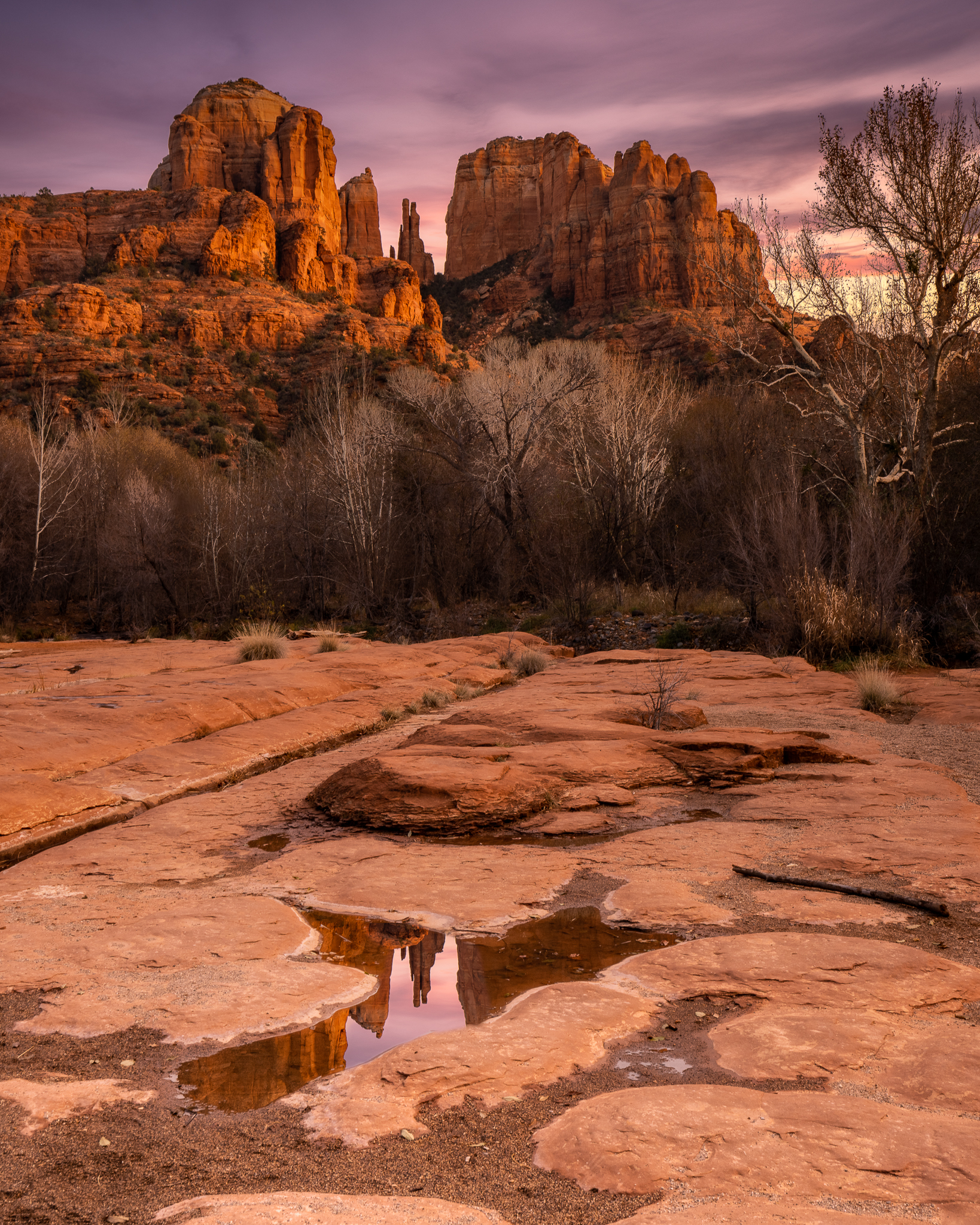
Like many photographers, I’d seen those dreamy reflections of Cathedral Rock online. My pre-trip planning began with Google Maps. One location stood out: a slickrock stretch north of Oak Creek, about 1,189 feet east of Crescent Moon Picnic Site. My goal? Find a natural mirror in time for sunset.
Little did I know, many viral shots stem from a spot called Secret Slickrock. I hadn’t marked that then—just knew the area drew crowds chasing golden hour magic. With time slipping away, I followed the creek east, avoiding the temptation to wade through icy water like another photographer I spotted on the trail.
Then I found it: a small basin of still water nestled in the slickrock. A shallow enough pool to reflect Cathedral Rock’s center spire. The scene was forming—but the clock was racing.
📸 Location: Baldwins Crossing
I arrived with no guarantee of water—just hope. A recent ice storm had altered my travel plans, delaying a hike at the Wave. But now, Sedona offered a quiet reward. This humble pool was enough. Had conditions been drier, I might’ve tried Buddha Beach or attempted to move water from Oak Creek to build a scene.
Instead, the reflection was waiting for me—silent and symmetrical.
🔧 Camera Settings that Made the Moment
Sunset light doesn’t linger. Shadows from the Mogollon Rim uplift were already creeping across the center draw, which ruled out focus stacking. I needed everything sharp in one go.
Here’s the setup:
Camera: Sony A7R-series body
Lens: Sony FE 16–35mm F2.8 GM
Aperture: f/14 for full depth sharpness
ISO: 125 for clean tones and dynamic range
Focal Length: 35mm to minimize distortion
Exposure Strategy:
Manual bracketing of three exposures
-0.7 EV compensation to control highlight blowout
Balanced tonal gradient across rock, sky, and water
🧠 Compositional Thinking
I positioned the tripod to align Cathedral Rock and its reflection into a near-perfect vertical axis. Slickrock texture anchored the foreground; desert brush added contrast in the mid-ground. The challenge wasn’t just lighting—it was balancing intimacy with scale.
While I often use the rule of thirds, here I relied more on spatial layering:
Foreground: Slickrock with water basin
Middle Ground: Desert vegetation providing transition
Background: Cathedral Rock rising with terraced structure
Color theory played a role: warm sandstone, neutral greens, and cool slickrock—forming a triadic palette that balanced the frame.
📊 Histogram Results
I underexposed slightly to deepen shadows—a choice that pushed the histogram left but kept data intact:
No clipping in highlights or shadows
Midtones softly distributed
Red channel bump matched the stone’s color dominance
White balance tuned to keep reflections calm and natural
🌄 Sedona’s Quiet Canvas
Baldwins Crossing isn’t just a place—it’s an experience. You won’t always find a reflection. You might be alone. But if you’re patient, light and landscape will align.
That day, I didn’t just capture Cathedral Rock—I discovered it.

 Dec 16, 2021
 5:21 PM
 Sony ILCE-7RM3
 FE 16-35mm GM
 35.0 mm
 ƒ/14
ƒ/14
 125
125
 1.6
1.6
 Flash
Flash